Chinese licorice root slices and powder with tested glycyrrhizin content, for confectionery, beverage, tobacco and herbal applications. Grown in the dry northern belt of Inner Mongolia, Xinjiang and Ningxia.
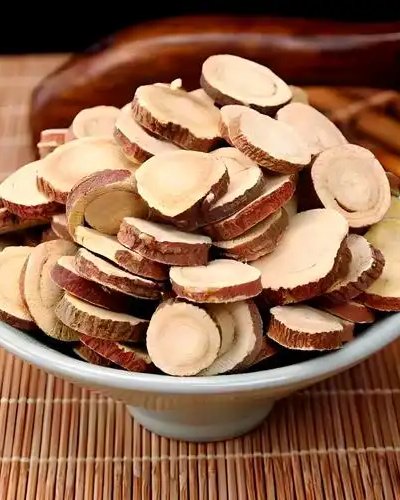
Chinese licorice (Glycyrrhiza uralensis) is grown in the dry northern belt — Inner Mongolia, Xinjiang and Ningxia — where slow growth produces dense roots with high glycyrrhizin. It is roughly fifty times sweeter than sucrose in the compounds that matter.
Root is harvested at three to four years, washed, sliced and dried. Glycyrrhizin content varies with growing age and root diameter, so sliced root for retail and extract grade are usually separated at the processing stage rather than after.
Sliced root in two visual grades plus powder, with glycyrrhizin reported per lot.
| Attribute | Sliced (Premium) | Sliced (Standard) | Ground Powder |
|---|---|---|---|
| Origin | Inner Mongolia / Xinjiang / Ningxia, China | Inner Mongolia / Xinjiang / Ningxia, China | Inner Mongolia / Xinjiang / Ningxia, China |
| Appearance | Uniform slices, yellow interior, clean bark | Slices with size and colour variation | Light brown powder |
| Moisture | ≤ 12% | ≤ 12% | ≤ 10% |
| Glycyrrhizin | ≥ 4.0% | ≥ 2.5% | ≥ 2.5% |
| Impurities | ≤ 0.5% | ≤ 1.0% | ≤ 1.0% |
| Typical Use | Extraction, pharma, premium tea | Food service, blending | Confectionery, beverage, blends |
| Packaging | 25 kg carton / bale | 25 kg PP bag | 25 kg bag / carton |
Indicative specifications for standard presentations. Final values are confirmed against your requirements and per lot — full technical data sheet, COA and sample analysis available on request.
Typical applications in food manufacturing, food service and extraction. Custom cuts, blends and specifications are available on request.
Licorice sweets, chewing gum and sugar-free sweetening systems.
Herbal teas, throat preparations and functional drinks.
Casing ingredient and mouthfeel modifier in oral products.
A harmonising ingredient in traditional Chinese formulations.
Every shipment undergoes physical inspection, moisture testing and active-content verification. Third-party lab testing (SGS, Eurofins, BV) and complete import documentation can be coordinated per order.
Import clearance depends on paperwork as much as on the goods. Below is what we hold and what we can prepare for your destination market — confirmed per order rather than claimed as a blanket certification.
Held. Copy provided on request for buyer verification and supplier approval.
Held. Export documentation is coordinated against each order and destination market.
Food-safety system documentation supplied on request during supplier qualification.
Arranged on request where the destination market or buyer requires it.
Aflatoxin, pesticide residue, heavy metals and microbiology tested per lot on request.
FDA labelling and prior-notice guidance, plus EU import documentation, prepared on request.
Documents are issued per shipment and vary by product and destination. Copies of licences and certificates are provided on request during supplier qualification.
Flexible packaging options to suit retail, food manufacturing and bulk container orders.
25 kg carton
Retail / food manufacturing
25 kg / 50 kg
Industrial / bulk buyers
1 MT jumbo bags
Full container loads
Custom carton design
Bag sizes & labeling
Container loading varies with product density and packaging — typically 18–24 MT per 20′ container for whole spices and less for low-density herbs and leaf. Final packing, palletisation and container plan are confirmed per order.
A complete export documentation package to support import clearance and buyer due diligence.
Quick answers to common buyer questions. For detailed technical data, please request our product brochure.
No. Chinese licorice is Glycyrrhiza uralensis; the Mediterranean species is G. glabra. Both contain glycyrrhizin but differ in secondary compounds and sweetness profile, so they are not always interchangeable in formulation.
Our standard offer is sliced root and powder. Extract, paste and refined glycyrrhizin are separate product lines and can be quoted on request.
Our standard MOQ for Licorice Root is 1 MT per grade, so a buyer can run a trial lot through their own line before committing to a container. A 20′ container holds roughly 18–24 MT depending on product and packing; a 40′ FCL is quoted on the same basis.
Yes. 200 g–500 g samples of Licorice Root are supplied free of charge for evaluation; the buyer covers courier freight, or the sample can travel with the first shipment. Tell us the grade, packing form and destination and we cut the sample from the current lot.
Production runs 25–30 working days from order confirmation, depending on grade, packing and current stock. Licorice Root then moves to Qinzhou port, or the port you nominate; ocean transit is quoted per destination when freight is confirmed.
We typically accept T/T (30% deposit, 70% against B/L copy) or L/C at sight for new buyers. Repeat buyers can move to negotiated terms after the first shipments.
Yes. Bag size, carton design and label content can follow your market's rules, and we send a dieline proof before the run starts. Custom packaging starts at 1,000 kg per design.
The standard set is COA, phytosanitary certificate, certificate of origin, commercial invoice, packing list and bill of lading. Pesticide residue, aflatoxin, heavy metal and microbiology reports for Licorice Root are issued by third-party labs such as SGS, Eurofins or BV on request. We do not hold an FDA facility registration; for US imports we support your importer's FSVP and prior-notice paperwork with batch-level documents.