Key points
- A grade is five measurable properties: wholeness, size uniformity, colour, moisture, and volatile oil plus contaminants.
- Moisture above roughly 13% is the most common cause of mould claims after a long sea voyage.
- Two suppliers can both say “Grade A” and still differ by 4% moisture and 6% broken pods.
- Ground star anise loses aroma fast and is the form most often used to hide whole-material defects.
What a spice grade actually describes
A grade is not a marketing label — it is a bundle of measurable properties that decide what your line can do with the material. For star anise, five properties carry almost all of the commercial weight:
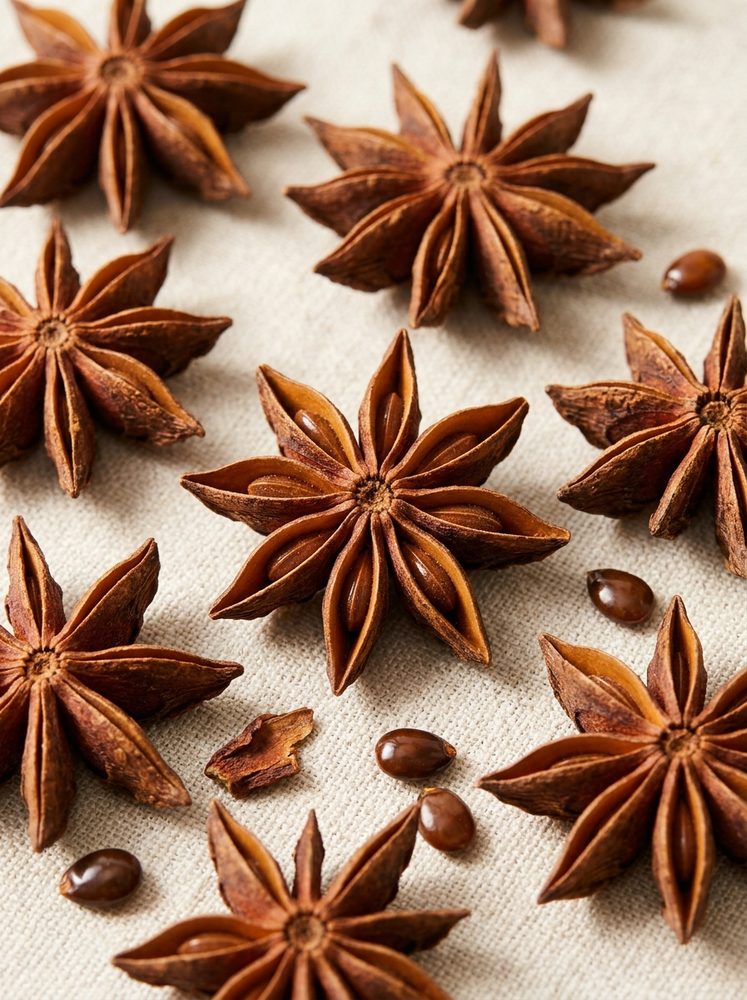
- Wholeness. The share of intact, eight-pointed pods. Whole pods hold their volatile oil far longer than broken pieces, and they are what most retail and food-service buyers pay a premium for.
- Size and uniformity. Pod diameter and the consistency of that diameter across the lot. Mixed sizes read as a lower grade even when the average size is fine.
- Colour and appearance. Even russet-brown pods with no mould, no insect damage, no dark water stains. Sun-drying and storage discipline show up here before they show up anywhere else.
- Moisture. The single most expensive variable to get wrong. Above roughly 13% the lot becomes a mould risk during a 25–35 day sea voyage, and you will not see the damage until the container is opened.
- Volatile oil and contaminants. Anethole content drives flavour; aflatoxin, pesticide residues, heavy metals and microbiology decide whether the lot can legally enter your market.
Two lots can both be called “Grade A” by two different suppliers and still differ by 4% moisture, 6% broken pods and 40% of the volatile oil range. That is why a grade name without numbers is not a specification.
The four star anise grades we quote
Most bulk enquiries settle into one of four forms. The numbers below are indicative ranges from our Yulin supply — final values are confirmed per lot against a pre-shipment sample.
| Grade | Whole pods | Moisture | Foreign matter | Typical use |
|---|---|---|---|---|
| Select whole | ≥ 95%, uniform 8-point | ≤ 12% | ≤ 0.5% | Retail packs, premium blends, extract |
| Grade A whole | 90–95% | ≤ 12.5% | ≤ 1% | Food manufacturing, catering supply |
| Broken / cut | 30–70%, cut to size | ≤ 12.5% | ≤ 1% | Seasoning sachets, grinding, oleoresin |
| Ground powder | — (60–80 mesh) | ≤ 12% | ≤ 0.5% | Blending, bakery, instant noodles |
Indicative ranges only. Volatile oil, aflatoxin, pesticide residues, heavy metals and microbiology are confirmed per lot and per destination market.
Ground star anise deserves a warning: powder loses aroma quickly and is the grade most often used to hide defects in the whole material. If your process can grind on arrival, buy whole and grind at destination.
Reading a certificate of analysis
A COA is the document that turns a grade name into something you can hold a supplier to. When one lands on your desk, read it in this order:
- Lot identity. Does the lot number match the packing list and the bags on the pallet? A COA that cannot be tied to a specific lot is decoration.
- Moisture. Compare against the contract, not against a generic web page. A 1% gap over 18 MT is roughly 180 kg of water you paid freight on.
- Volatile oil. Star anise typically sits in the 8–10% v/w range on a dry basis. Ask for the test method; results from different methods are not directly comparable.
- Aflatoxin. The EU sets 10 µg/kg total aflatoxins and 5 µg/kg for AFB1 in dried spices under Regulation (EU) 2023/915. Confirm the reporting limit, not just pass/fail.
- Pesticides and heavy metals. Relevant for EU and increasingly for Gulf markets. Request the multi-residue panel, not a single compound.
- Microbiology. Total plate count, yeast and mould, E. coli, Salmonella — the panel your own HACCP plan requires.
If a supplier cannot produce a lot-linked COA before shipment, treat the grade as unverified. Third-party testing through SGS, Eurofins or Bureau Veritas can be arranged on request, and we recommend it for first orders in any new market.
How to write an order specification
A specification that survives a 12,000 km supply chain has seven lines. Anything shorter leaves room for interpretation, and interpretation always favours the seller.
- Product and form — Illicium verum, whole pods, 8-point.
- Grade and tolerances — whole ≥ 95%, broken ≤ 5%, foreign matter ≤ 0.5%.
- Moisture — maximum, with the test method.
- Food safety limits — aflatoxin, pesticides, heavy metals, microbiology, each tied to the destination regulation.
- Packing — 25 kg PP woven with food-grade liner, or 1,000 kg jumbo bag; label content; palletisation if required.
- Quantity and shipment — metric tonnes, container type, Incoterm, destination port.
- Acceptance — pre-shipment sample approval, third-party inspection, and what happens if the lot fails.
Practical tip: attach a photo of the sample you approved to the contract. “As per sample dated 12 March” ends more arguments than any adjective in the specification.
Five mistakes that cost money
1. Buying the label instead of the numbers
“Grade A” is not a standard. It means whatever the seller wants it to mean that week. Convert it into percentages before you sign.
2. Ignoring moisture because the sample felt dry
A sample kept in an air-conditioned office tells you nothing about a bag sitting in a container for a month. Specify a maximum and test it at loading.
3. Assuming grades are comparable across origins
Chinese star anise, Vietnamese star anise and (unrelated) Japanese star anise are different products with different pricing. Illicium verum from China and Vietnam can look similar and still differ in anethole content and residue profile.
4. Forgetting that pallets cost payload
Palletised cargo is easier to handle and typically carries 2–4 MT less per 20′ container than floor-loaded bags. Decide which one your warehouse actually wants before you book.
5. Skipping the pre-shipment inspection on a first order
The inspection costs a fraction of a claim. On first orders, it is the cheapest insurance in the trade.
Container and packing maths
Star anise for export normally moves in 25 kg PP woven bags with a food-grade inner liner, or in 1,000 kg jumbo bags for industrial buyers. A 20′ container takes roughly 18–24 MT depending on packing, palletisation and destination weight limits; a 40′ HC takes proportionally more but is often capped by the buyer’s warehouse handling rather than by volume.
Three numbers are worth fixing before you request a quotation: the grade, the total tonnage, and the destination port. With those three, a supplier can quote a real price instead of a range. Our minimum order is 1 MT per grade, which lets a buyer test a lot through their own line before committing to a container.
Frequently asked questions
What is the difference between Select and Grade A star anise?
Select (premium) whole star anise is at least 95% intact eight-pointed pods with more uniform size and a tighter foreign-matter limit; Grade A is 90–95% whole with slightly wider tolerances. The practical difference is yield after your own sorting step.
What moisture content should I specify for sea freight?
Set a maximum of 12–12.5% for whole pods and 12% for ground. Higher moisture plus a long voyage is the most common cause of mould claims, and the damage is usually invisible until the container is opened.
How much star anise fits in a 20ft container?
About 18–24 MT in 25 kg bags, depending on packing, palletisation and the weight limit at destination. Palletised cargo carries roughly 2–4 MT less than floor-loaded bags.
Can you supply a lot-matched sample before I commit?
Yes. We send 200–500 g samples free of charge with freight paid by the buyer, drawn from the lot we intend to ship, so what you approve is what you receive.
Is star anise the same as aniseed?
No. Star anise is Illicium verum, an evergreen tree fruit from southern China and Vietnam; aniseed is Pimpinella anisum, an unrelated herb seed. Both are dominated by anethole, which is why they are often substituted, but they are different commodities with different HS codes.