Key points
- Cassia and Ceylon cinnamon are different species; the coumarin limits that matter apply to finished foods, not to bark.
- EU limits run 50 / 20 / 15 / 5 mg/kg by food category and convert into an inclusion rate: limit ÷ lot coumarin × 100.
- Quills, chips, smoked bark and powder are four different products — smoked cassia is a process, not a grade.
- Ask for a measured coumarin figure on the lot that ships; a species name does not predict the number.
Four forms, four different products
A cassia quotation that does not name the form is not a quotation. The same bark leaves Guangxi as four commercial presentations, and they are not interchangeable on price or on performance.
| Form | What it is | Where it goes | Indicative spec (confirm per lot) |
|---|---|---|---|
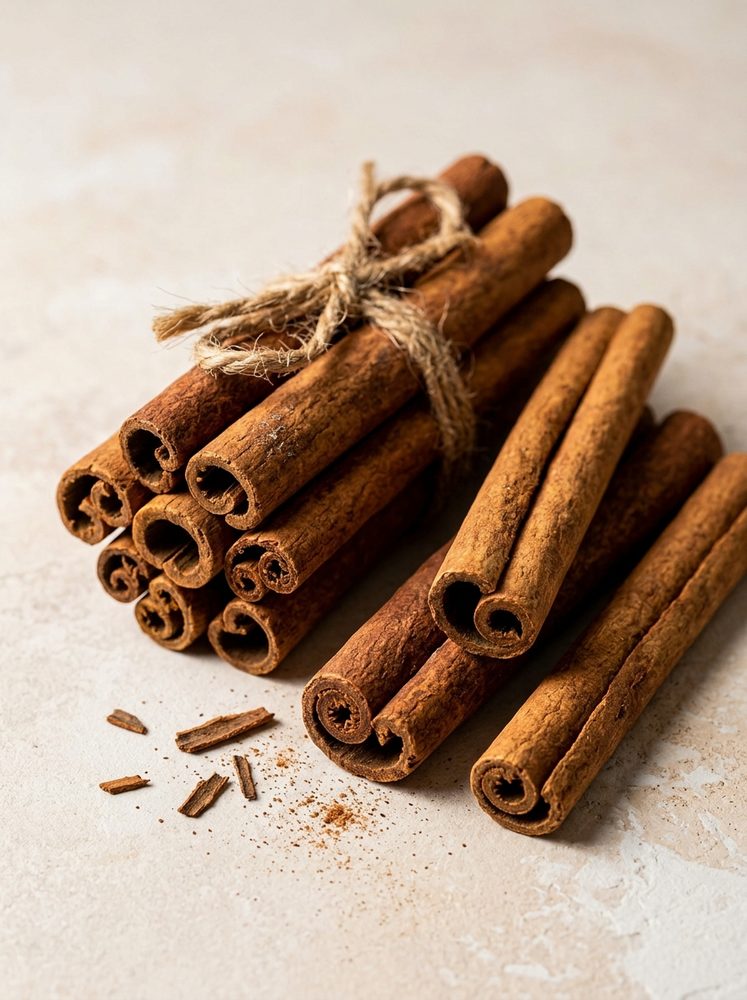
| Whole quills | Bark stripped and rolled, 1–3 mm thick, red-brown | Retail, bakery, beverage | Moisture ≤ 13%, essential oil ≥ 1.5 ml/100 g |
| Chips | Irregular pieces from lower grades | Industrial grinding, extraction | Moisture ≤ 13%, essential oil ≥ 1.0 ml/100 g |
| Smoked bark (yan gui) | Dried over wood fire, distinct smoke profile | Chinese braising, regional blends | Moisture ≤ 13%, essential oil ≥ 1.2 ml/100 g |
| Ground powder | Milled from chips or quills | Bakery, cereal, seasoning | Moisture ≤ 12%, essential oil ≥ 0.8 ml/100 g |
Indicative specifications for standard presentations. Final values are confirmed against your requirements and per lot.
Two consequences follow. First, quill and chip prices are not comparable per kilogram — one is a retail object, the other is feedstock. Second, smoked cassia is a process, not a grade. A supplier who lists “smoked” next to “Grade A” is describing two unrelated axes, and the buyer ends up paying for a word.
Coumarin: the regulation is on the finished food, not the bark
This is where most cassia specifications go wrong. Buyers write a coumarin limit into the bark spec, then discover the number has no legal basis — and, worse, that complying with it does not by itself make their product compliant.
Under Regulation (EC) No 1334/2008 — the EU regulation on flavourings and certain food ingredients with flavouring properties — Annex III sets coumarin limits for specified compound foods. Those limits apply to the finished food, not to cinnamon bark as an ingredient:
- Traditional and/or seasonal bakery ware with a reference to cinnamon on the label: 50 mg/kg
- Breakfast cereals, including muesli: 20 mg/kg
- Fine bakery ware other than the above: 15 mg/kg
- Desserts: 5 mg/kg
There is no EU maximum for coumarin in cinnamon bark as such. That gap is the buyer’s problem to manage, and it is manageable with one line of arithmetic:
Maximum inclusion rate (%) = finished-food limit ÷ lot coumarin figure × 100
If a lot tests at 2,000 mg/kg and the finished product is fine bakery ware at 15 mg/kg, the ceiling is 0.75% of the recipe. At 3,000 mg/kg it is 0.5%. The number you actually need from the supplier is therefore not a pass/fail against an invented bark limit — it is a measured value per lot, so you can run the calculation against your own formulation and your own category.
Two practical notes. Coumarin content varies with species, origin, plant part and lot, so it cannot be inferred from the species name: ask for a measured figure on the lot offered. And in the US, 21 CFR 189.130 prohibits added coumarin, but it does not set a limit for coumarin naturally present in cinnamon; requests for a per-lot figure therefore tend to come from the buyer’s own retail customers rather than from the regulator.
If your destination is the EU or the UK and your application is coumarin-sensitive, ask for the coumarin result on the lot that will actually ship, from a laboratory you can name. A certificate that predates the crop is not evidence about your container.
The seven lines that belong in a cassia specification
- Species and botanical name — Cinnamomum cassia, not “cinnamon”.
- Form and cut — quill length range, chip size, powder mesh.
- Volatile oil — the aroma line. Our standard presentations run 0.8–1.5 ml/100 g depending on form; specify against the point of delivery on a long sea leg, because oil declines in storage.
- Moisture — 12–13% by form. This is a freight decision as much as a quality one.
- Foreign matter — 0.5–1.5% by form; for powder, add a metal-detection statement.
- Coumarin — a measured figure, stated as mg/kg, per lot.
- Microbiology and treatment — whether the material is steam-treated, and the panel your market requires. Treatment status has to be agreed before packing; it cannot be added at the port.
Add packaging (25 kg carton, bale or PP bag), pallet specification and marking if the goods are going to a distribution centre rather than a plant.
How a cassia order actually runs in Yulin
Bark is stripped from coppiced stems, dried, and rolled into quills of varying length; the shorter and broken material becomes chips for grinding, which is why chip supply is steadier than quill supply late in the season. Smoking, where specified, happens at drying rather than after grading, so a smoked order is planned before the bark is cut, not selected from stock afterwards.
The part buyers underestimate is sampling. A sample drawn from a display table tells you what the trader can find, not what the container holds. Ask for the sample to be drawn after the lot is packed, sealed, and identified by batch — and keep a retained sample on both sides until the goods are accepted at destination. When a third-party inspection is booked (SGS, Eurofins, BV are the usual names), the inspector should pull from the stuffed lot against your written spec, not against the supplier’s own grade sheet.
Our standard terms for a first cassia order: MOQ 1 MT, lead time 25–30 working days from deposit, T/T 30% deposit and 70% against documents or sight L/C, shipment from Qinzhou. Samples of 200–500 g are free with freight at the buyer’s cost, which is the cheapest way to settle the volatile-oil and colour question before anyone talks about tonnes.
US & EU Market Support — FDA labelling and prior-notice guidance, prepared on request.
Five mistakes that cost money on cassia
1. Buying “cinnamon” without a Latin name
Ceylon and cassia behave differently in formulation, and they sit differently against coumarin limits in practice. The species line settles it.
2. Writing a coumarin limit into the bark spec
It is not a legal category. Convert the finished-food limit into an inclusion rate instead.
3. Comparing quill and chip quotes per kilogram
Different products, different buyers, different price logic.
4. Ignoring moisture because the sample felt dry
13% bark and 9% bark behave the same in a hand and differently in a container.
5. Leaving treatment status to the port
Steam treatment, irradiation and untreated material are three different supply chains.
Frequently asked questions
What is the difference between Chinese cassia bark and Ceylon cinnamon?
They are different species. Chinese cassia (Cinnamomum cassia) has thicker, single-layer bark and a much higher cinnamaldehyde content, which gives a stronger, warmer note suited to bakery and seasoning. Ceylon cinnamon (C. verum) is softer, more layered and lighter in flavour, and is usually chosen where a low coumarin figure is the deciding factor.
How much coumarin is in Chinese cassia bark?
It varies by lot and by species, which is why we report a measured figure per lot rather than quoting a range. Ask for the coumarin result on the specific lot offered, from a named laboratory, and convert it into an inclusion rate against your finished-product limit.
What is the minimum order quantity for cassia bark from China?
Our minimum is 1 MT for a standard presentation, with a lead time of 25–30 working days from deposit. Mixed containers combining cassia with other spices are possible when the total volume justifies it.
Can you supply smoked cassia bark (yan gui)?
Yes. Smoked cassia is dried over wood fire in Guangxi and carries a distinct smoky profile used in Chinese braising blends. It is a process specification rather than a grade, so it is agreed before the bark is cut.
Is cassia bark the same as cinnamon powder?
No. Powder is milled from chips or quills and loses volatile oil faster than whole bark — our indicative floor is 0.8 ml/100 g for powder against 1.5 ml/100 g for quills. If you mill at destination, buy bark; if you buy powder, specify mesh and a volatile-oil minimum at delivery.